

Nick Sleep
How a windsurfer-turned-investor proved that in markets, as in life, the loudest voice in the room is silence
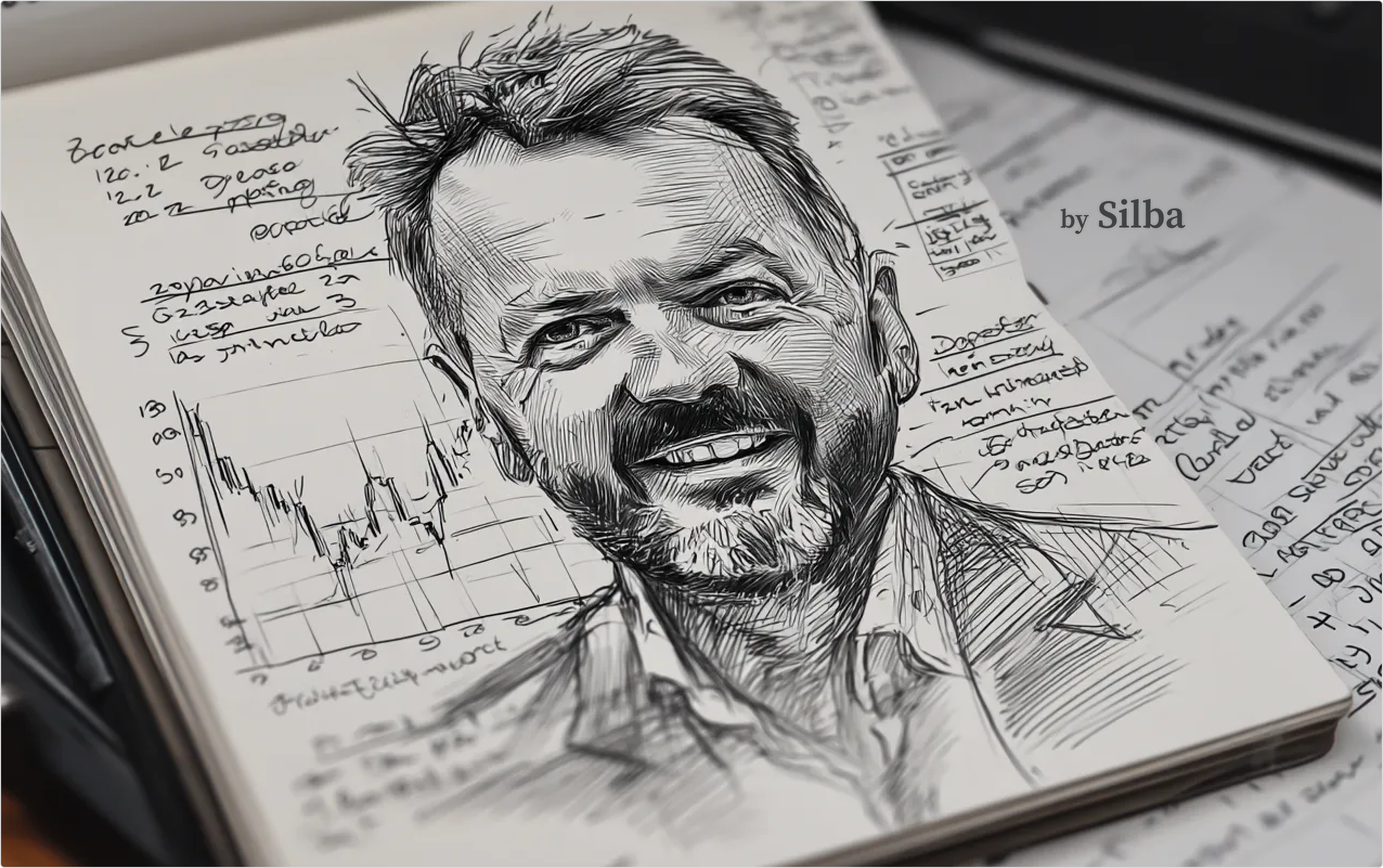
Nick Sleep made a fortune by holding three stocks. Then he vanished.
Not vanished like "moved to Switzerland." Vanished like "refused to exist in public." No interviews. No conferences. No Twitter. Just gone.
The most successful investor you've never heard of spent thirteen years proving that the secret to extraordinary returns is extraordinarily simple: buy businesses that give their profits away, hold them forever, then disappear before anyone notices you've cracked the code.
Wall Street is still pretending not to understand.
Lesson One: The Customer Is Your Hedge Fund (And They Don't Know It)
Here's a $30 story that explains modern capitalism:
A Costco buyer finds designer jeans. Marks them up 16%. Company policy says 14% max. Jim Sinegal, the founder, discovers this tiny rebellion and delivers what amounts to the Sermon on the Mount of retail: "If I let you do it this time, you will do it again. The contract with the customer must not be broken."
Two percent. That's what we're talking about. Two. Percent.
Wall Street sees this and thinks: idiots. Nick Sleep sees this and thinks: genius.
But why?
Sleep discovered something so obvious it's invisible: businesses that systematically undercharge create a mathematical impossibility for competitors. He called it "scale economics shared." (Finance people need fancy names for simple ideas. It's a disease.)
The math: Costco customers save $5 for every $1 shareholders earn. A 5:1 "robustness ratio." Imagine running a business where your customers are literally better off shopping with you than keeping their money. Now imagine competing against that business.
You can't.
That's the point.
Sleep realised this wasn't new. Henry Ford did it in 1914 (doubled wages, scandalised investors, created an entire middle class of customers). Sam Walton did it. Jeff Bezos definitely did it. But somehow between Ford and Bezos, business schools forgot that making your customers rich makes you richer.
Sleep didn't forget. He did the opposite of forgetting. He built an entire philosophy around remembering.
Lesson Two: Concentration Is Only Risky If You're Wrong
By 2014, Sleep's portfolio looked like this:
Amazon: 40%
Costco: 30%
Berkshire Hathaway: 20%
Everything else: 10%
Your financial advisor just had a stroke.
Three stocks (essentially). Thirteen years. 921% returns versus the market's 117%.
(Yes, you read that right. He turned every $1 million into $10.21 million while the index turned it into $2.17 million.)
Here's how Sleep thought about position sizing, and it's wonderfully perverse: Start by imagining 100% in one stock. Then work backwards. What would prevent total commitment? Competition? Regulation? Technological disruption? If the answer is "nothing," buy more.
Everyone else builds portfolios by adding positions. Sleep built his by subtracting doubt.
The entire financial industry exists to make this seem complicated. Diversification theory. Modern portfolio optimization. Risk-adjusted returns. Sleep's response was essentially: "Or... you could just own three things you understand."
His edge wasn't genius. It was conviction.
And patience. Geological-scale patience. (Sleep studied geology at Edinburgh before stocks. This explains more than it should.)
Lesson Three: The Best Investors Eventually Stop Investing
In 2014, at age 45, peak performance, peak reputation, peak everything, Sleep did something unthinkable.
He gave it all back.
Not the money, he'd earned that fair and square. The fund. The platform. The two-and-twenty. Everything Wall Street kills for.
His letter to Warren Buffett should be taught in business schools: "The real work is done by you and the good people at Berkshire." Translation: We didn't create value. We recognised it. There's a difference.
Then Sleep told his investors to just... hold the three stocks. Don't trade. Don't optimise. Don't even think. Just hold.
What happened next is almost annoying in its predictability:
Amazon: +950% (2014-2021)
Costco: +282%
Berkshire: +115%
The portfolio kept compounding without its creator. Like a Swiss watch in an abandoned mansion. Tick. Tick. Tick.
Sleep now chairs the Legacy Youth Zone in Croydon. Five thousand five hundred kids getting sports, arts, and actual opportunity instead of another fund manager getting another yacht. He applies the same analysis to social impact that he did to stocks: long-term thinking, compound effects, patient capital.
(And yes, the fact that this makes more sense than managing money tells you everything about how finance people see the world.)
The Magic Formula That Isn't
Sleep's approach can be reduced to three steps:
Find businesses that systematically undercharge customers
Buy them when everyone thinks they're stupid
Hold until the heat death of the universe
That's it. That's the whole strategy.
A sixth-grader could understand it(!). Which is probably why MBAs can't.
The formula works because it exploits a structural flaw in capitalism: the gap between quarterly thinking and geological time. Most investors can't hold a stock for three years. Sleep held for thirteen. In a game where everyone else is playing checkers at light speed, he played chess in slow motion.
What This Really Means
Right now, thousands of fund managers are sitting in glass towers, surrounded by Bloomberg terminals, paying millions for proprietary data, running models that would make NASA jealous, all to achieve returns that a vanished geologist beat by owning three stocks and (I'm guessing) checking his email twice a year.
Sleep understood something they don't: complexity is a moat for the manager, not the investor.
His influences:
Windsurfing: Taught him to read patterns and wait for perfect conditions (or so I imagine, what else does windsurfing teach you?)
Geology: Gave him a time horizon measured in eons, not earnings seasons
Department store work: Showed him how actual humans spend actual money
Not exactly the Harvard-to-Goldman pipeline.
Sleep's real innovation wasn't finding new information. It was ignoring most information. As he wrote: "Information, like food, has a sell by date." Next quarter's earnings? Worthless after next quarter. But whether a business treats customers like partners or prey? That compounds forever.
The Part Nobody Talks About
According to Mohnish Pabrai (who manages over a billion dollars and credits Sleep with transforming his entire approach), Sleep tripled his wealth in the five years after "retiring."
He manages his personal money the same way he managed Nomad: extreme concentration, infinite patience, zero noise. Pabrai reports that Sleep sometimes holds 70% of his net worth in a single stock. (Sleep once sold half his Amazon position when it reached this level, a decision he later regretted as the stock kept climbing.)
Seventy percent. In one stock.
Your financial advisor just had another stroke.
But here's what's really subversive: Sleep made all his letters public. For free. Around 200 pages of investment philosophy that hedge funds would pay millions for, downloadable by anyone with an internet connection through the I.G.Y. Foundation.
It's scale economics shared applied to intellectual property. Give away your best ideas, create a generation of better investors, improve the entire ecosystem. The man who got rich by recognising businesses that give away value is giving away the blueprint for recognising businesses that give away value.
Meta? Sure. Effective? The evidence speaks for itself.
Three Truths and a Lie
Truth #1: The best investments look stupid at the beginning and obvious at the end. (Amazon trading below eBay's valuation. Costco's "pathetic" margins. Berkshire, well, everyone thought Buffett was done for in 1999.)
Truth #2: Doing nothing is harder than doing something. (Try holding three stocks for thirteen years. Try not checking prices. Try explaining to your spouse why you're not "diversifying.")
Truth #3: The most valuable information is usually free and ignored. (Annual reports. Store visits. Basic arithmetic. Everything Sleep used is public.)
The Lie: You need to be smart to beat the market. (You need to be patient. There's a difference. One is rare.)
Where It Leaves Us
Somewhere right now, a 25-year-old is reading Sleep's letters and realising that everything they learned about investing is backwards. That complexity is a tax, not a tool. That the best strategy might be having no strategy at all beyond: find great businesses, buy them, and then, this is the hard part, do absolutely nothing.
They'll probably be told they're naive. That markets are efficient. That this time is different. That they need alternatives and hedges and a view on the Fed.
Nick Sleep proved otherwise. Then he disappeared, leaving only his ideas behind. Like footprints in stone, another geology metaphor that explains more than it should.
The game isn't complicated. We just pretend it is because simple is scary when your job depends on complexity.
But Sleep knew what the Stoics knew, what Buffett knows, what every great investor eventually learns: the highest form of action is inaction. The greatest edge is patience. And the best time to do nothing is usually right now.
According to Sleep himself:
Good investing is a minority sport...
one of the things the crowd is not, is patient.
Mic drop
There could be a lot of Nick Sleeps who tried this approach and went bust. For every Warren Buffett and Nick sleep there are a load of people who concentrated their investments on stocks that went no where and they never sold them.
They could be following the same strategy of no strategy and in action and it going terribly wrong.
Buffett went on a lot longer and brought a lot more companies (because he had a lot more money to invest and couldn't stuff them all in a few stocks).
Nick sleep brought a lot more companies, which he goes through in his letters.
I always enjoy reading about Nick Sleep because his thoughts and ideas are interesting and he has a quiet way to his approach which is different from many other people in finance.
Eventually, there are no heroes in investing (or very few).
Nick Sleep put the proceeds from the Amazon sale you mentioned into ASOS. The company lost 90% of its value in the last five years and, it appears by the numbers, is structurally drifting towards obsolescence.